Local GuidesWater Treatment
Choosing the Right Water Softener Size for Your Household
Most Diamond Bar homes need a 32,000 to 48,000 grain softener. Here is the hardness math, the salt math, and how to size yours right the first time.
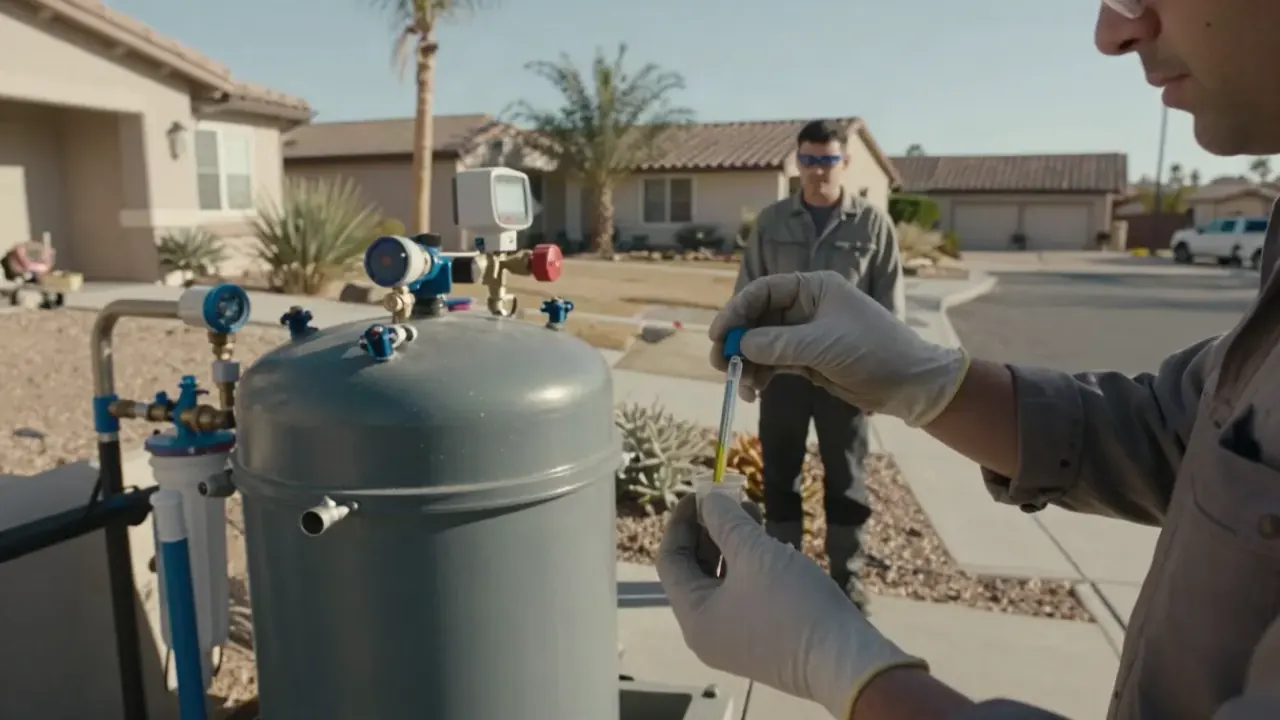
Most single-family homes in Diamond Bar need a water softener rated between 32,000 and 48,000 grains, and a family of four on Diamond Bar's hard water usually lands at 40,000 grains or higher. Choosing the right water softener size for your household comes down to three numbers: your water hardness in grains per gallon, your daily water use in gallons, and how often you are willing to load salt. Get those three right and the unit will keep up for years. Get them wrong and you will either overspend on capacity you never use or burn through salt and resin fighting a softener that is too small.
We install and service softeners across Diamond Bar, and the sizing mistakes we see are almost always the same ones. This guide walks through the math, the local hardness numbers, and the household profiles that actually matter.
What Size Water Softener Do You Actually Need?
In Diamond Bar, a two-person household typically needs a 24,000 to 32,000 grain softener, a family of four needs 32,000 to 48,000 grains, and a household of five or more with heavy laundry and irrigation use should be looking at 48,000 to 64,000 grains. Those ranges assume a hardness level between 12 and 18 grains per gallon, which is what we measure on most Diamond Bar properties. If your home tests higher, or if you have a pool, an extra bathroom, or a large landscaped lot, move up one size.
The reason the answer is a range and not a single number is that softener sizing is not about the house. It is about how much calcium and magnesium your household pushes through the unit every day. A retired couple in a 2,400 square foot home on a quarter-acre lot can use less water than a family of five in a 1,800 square foot townhome. Square footage tells you almost nothing.
What we do before quoting any system is a Water Hardness Testing Diamond Bar CA at the kitchen tap and the hose bib. That gives us the actual grains per gallon on your line, not a regional average. From there the sizing math takes about five minutes.
How to Size a Water Softener: The Three Numbers That Matter
How to size a water softener comes down to multiplying your daily water use by your hardness, then multiplying by the number of days you want between regenerations. Everything else is a detail. Here is the sequence we run on every Diamond Bar job.
1. Daily water use per person
The planning figure we use is 75 to 80 gallons per person per day for a typical Diamond Bar household. That covers showers, laundry, dishes, toilets, and the usual outdoor use. If you have a pool you top off in summer, or you run drip irrigation off softened water, add 20 to 30 percent.
2. Water hardness in grains per gallon
Diamond Bar water runs hard. Most of the properties we test land between 12 and 18 grains per gallon, with some pockets of the city pushing past 20. If you are on a private well rather than the municipal supply, we have seen readings into the high 20s. Hardness is the multiplier that turns a small household into a big softener requirement.
3. Days between regenerations
This is the number most homeowners never think about, and it is the one that decides whether you are hauling salt every week or every month. We size most Diamond Bar homes for seven days between regenerations. If you want to stretch it to ten or twelve days so you are not buying salt as often, you need more grain capacity. If you do not mind regenerating more frequently, you can size smaller and save on the unit.
Here is the formula in plain terms:
- Daily grains = people x 75 gallons x hardness in grains per gallon
- Required capacity = daily grains x days between regenerations
- Add 20 percent for a buffer so the unit is not running at 100 percent every cycle
A family of four at 15 grains per gallon: 4 x 75 x 15 = 4,500 grains per day. Times seven days is 31,500 grains. Add the buffer and you are at roughly 38,000 grains, which is why a 40,000 grain unit is the sweet spot for that household.
Water Softener Capacity Explained Without the Sales Pitch
Water softener capacity is the total amount of hardness minerals, measured in grains, that the resin inside the tank can remove before it needs to regenerate. The number on the box, like 32,000 or 48,000, is the resin's theoretical maximum. In real operation you never want to run the resin to its absolute limit, because efficiency drops and you start seeing hard water slip through before the next cycle. The practical working capacity is usually about 70 to 80 percent of the label number.
That is why a unit sold as 40,000 grains is realistically doing 28,000 to 32,000 grains of work per cycle. If your household needs 31,500 grains between regenerations and you bought a 32,000 grain unit, you are running it at the edge. It will work, but you will regenerate more often and use more salt than the spec sheet suggests.
Two other specs matter as much as the grain rating:
- Resin volume. A 40,000 grain unit should hold about 1.0 to 1.25 cubic feet of resin. If a unit claims 40,000 grains with 0.75 cubic feet of resin, the number is marketing, not engineering.
- Flow rate. You want a service flow rate that matches your peak demand, usually 8 to 12 gallons per minute for a Diamond Bar home with two or three bathrooms running at once. Undersized flow means pressure drop at the shower when the washing machine fills.
When we spec a system, we match the grain capacity to your household and the flow rate to your plumbing. A softener that is right on grains but wrong on flow will still disappoint you.
How Diamond Bar Water Hardness Changes the Math
Diamond Bar sits on water that is harder than the California average, and that single fact pushes most local households up one size compared to what a national sizing chart would recommend. The city's supply draws from a mix of imported and local sources, and hardness readings we take across town commonly fall between 12 and 18 grains per gallon. In the foothill neighborhoods on the south side, we have measured higher.
If you have been using a generic online calculator that assumes 7 to 10 grains per gallon, your result is going to be too small for a Diamond Bar home. A family of four that a national chart sizes at 24,000 grains actually needs closer to 40,000 here. That gap is the single most common reason we get called to replace a softener that was installed two or three years ago and never kept up.
Neighborhood matters less than the actual test, but we do see patterns. Homes in Diamond Point Water Softener territory and the older streets near Valle Lindo Water Softener service area tend to have plumbing that has been through a few softener generations already, and the hardness is consistent year to year. Newer construction on the ridge often has higher static pressure, which changes the flow-rate side of the sizing even when the hardness is the same.
Test first, size second. It is a fifteen-minute step that saves thousands.
Sizing by Household: One Person, a Family of Four, and Everything Between
Here is how the sizing shakes out for the household profiles we see most often in Diamond Bar, assuming 15 grains per gallon and a seven-day regeneration target.
- One to two people, low outdoor use: 24,000 to 32,000 grains. A 32,000 grain unit gives you comfortable headroom.
- Family of three: 32,000 to 40,000 grains. Most homes land on a 40,000 grain unit for the salt efficiency.
- Family of four: 40,000 grains is the standard answer. If you have a pool or heavy irrigation, go to 48,000.
- Family of five or more: 48,000 to 64,000 grains. At this size you also need to check that the unit's flow rate keeps up with simultaneous showers and laundry.
- Households with a well: size after testing. Well hardness in this area can run well past 20 grains per gallon, which can push a family of four into 64,000 grain territory.
If you are weighing a traditional salt-based softener against a Salt-Free Water Conditioners Diamond Bar CA setup, sizing works differently. Salt-free conditioners are rated by flow rate and pipe size rather than grain capacity, so the household math above does not apply the same way. We will walk you through which approach fits your water and your goals.
Common Mistakes We See in Diamond Bar Water Softener Sizing
The sizing errors we fix most often in Diamond Bar are not exotic. They are the same four or five mistakes, repeated.
- Sizing off square footage. A 3,000 square foot house with two occupants does not need the same softener as a 1,800 square foot house with five. Size off people and water use, not the floor plan.
- Using a national hardness average. At 15 grains per gallon, Diamond Bar is roughly double what a lot of online calculators assume. That alone undersizes most systems by one step.
- Buying the biggest unit on the shelf. Oversizing is not free. A 64,000 grain softener in a two-person home regenerates less often but uses more salt per cycle and can sit with stale brine between regenerations. Match the unit to the load.
- Ignoring flow rate. Grain capacity gets all the attention, but a unit that cannot deliver 10 gallons per minute at peak demand will drop your shower pressure every time the dishwasher runs.
- Forgetting the outdoor load. If you soften your irrigation or top off a pool, that water counts. We see households jump a full size once the outdoor use is included.
There is also the question of what happens after the softener. If you are dealing with taste and odor as well as hardness, a Whole-House Water Filtration Diamond Bar CA system paired with the softener handles both, and the sizing for each is done separately.
When to Call a Professional
Call us when you are not sure what hardness you are actually dealing with, when your current softener runs out of soft water before the next regeneration, or when you are replacing a unit and want the new one sized right the first time. Those are the three situations where a professional test and a proper sizing calculation save you money.
We test your water, calculate the daily grain load for your household, and recommend a capacity and flow rate that match. If your existing unit is the right size but not performing, the problem is usually mechanical rather than a sizing issue, and that is a different repair. If the unit is simply too small, we can talk through replacement options and what the swap involves.
Diamond Bar Water Softener handles sizing, installation, and service for households across the city. We work on salt-based softeners, salt-free conditioners, and the filtration that often goes with them. If you want a straight answer on what size your home needs, we will give you one after we test your water.
Frequently Asked Questions
What size water softener do I need in Diamond Bar CA?
Most Diamond Bar homes need 32,000 to 48,000 grains. A two-person household usually fits a 32,000 grain unit, a family of four needs 40,000 grains, and five or more people with heavy water use should look at 48,000 to 64,000 grains. These ranges assume 12 to 18 grains per gallon, which is typical here.
How do I size a water softener for my home in California?
Multiply your household size by 75 gallons per person per day, multiply that by your hardness in grains per gallon, then multiply by the days you want between regenerations. Add 20 percent as a buffer. In California, always test your actual hardness first, because regional averages vary widely from 5 to 25 grains per gallon.
Does water softener size matter in Diamond Bar?
Yes, more than in most cities. Diamond Bar water runs 12 to 18 grains per gallon, roughly double the national average. A softener sized for average US water will be one size too small here, which means frequent regeneration, higher salt use, and hard water slipping through before the next cycle.
What happens if my water softener is too small?
An undersized softener regenerates more often, uses more salt per gallon of soft water, and can run out of capacity before the next cycle. You will notice hard water spots returning, soap that will not lather, and a unit that seems to be running constantly. Resin also wears out faster under that load.
Can I oversize a water softener?
You can, and it is not free. An oversized unit regenerates less often but uses more salt per cycle and can sit with stale brine between regenerations. For most Diamond Bar homes, matching the unit to your calculated daily grain load beats buying the biggest model on the shelf.
Get Help With Water Softener in Diamond Bar
If you want your softener sized correctly the first time, we will test your water and run the numbers with you. We install and service systems across Diamond Bar and the surrounding neighborhoods, and we will tell you plainly what your household needs.
Call Diamond Bar Water Softener at (909) 415-2296 to schedule a water hardness test and a sizing consultation.