Local GuidesWater Treatment
Do You Need a Whole-House Water Filter Too
A softener removes hardness minerals. A whole-house filter removes chlorine, sediment, and taste. Here's how to tell if your Diamond Bar home needs both.
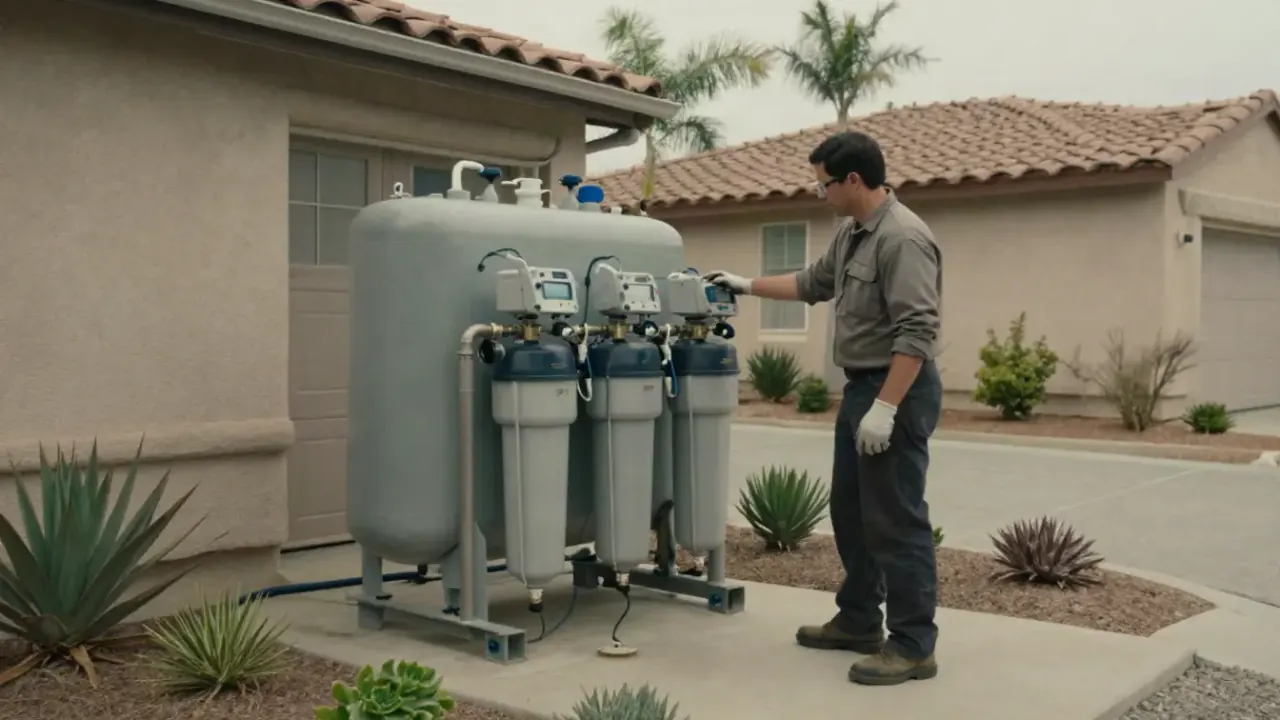
Yes, most Diamond Bar homes with a water softener still benefit from a whole-house water filter, because the two systems remove completely different things. A softener strips out calcium and magnesium, while a filter removes chlorine, sediment, and organic compounds the softener never touches. If your water feels slick but still smells like a pool, you already have your answer.
We install and service both systems across Diamond Bar, and the question comes up on nearly every estimate. Below we break down what each unit does, why our local water chemistry makes the combination worth it, and how to decide whether you need the filter or just the softener.
The Short Answer: Softener vs. Filter
A water softener is a mineral-removal device that swaps calcium and magnesium ions for sodium or potassium, while a whole-house filter is a contaminant-removal device that traps sediment and reduces chlorine, chloramine, and taste. They are not competing products. They solve two separate problems that happen to share the same plumbing line.
If you want the technical version: softening is an ion-exchange process inside a resin tank. Filtration is a physical and chemical process inside a media cartridge or carbon block. One changes the chemistry of the water. The other cleans what is floating in it.
That is why the question "do I need a whole-house water filter too" keeps coming up. Homeowners assume the softener is doing everything. It is not, and the gap shows up in your shower, your ice maker, and your drinking water.
What a Water Softener Actually Removes
A water softener removes hardness minerals - calcium and magnesium - and that is essentially its whole job. It does that job extremely well, which is why it fixes the visible symptoms of hard water.
Here is what changes once a softener is running properly in a Diamond Bar home:
- Soap and shampoo lather instead of curdling on your skin.
- Water spots on glassware and shower doors stop forming.
- Water heater scale buildup slows dramatically, which protects the tank.
- Dishwasher and washing machine parts last longer.
- Pipes keep their full inside diameter instead of narrowing with mineral deposits.
What the softener does not do is remove chlorine, chloramine, sediment, iron particles, or the earthy taste that comes through some municipal supplies. Those pass straight through the resin bed and out to your faucets.
If you have never had your water tested, that is the first step before buying anything. Our Water Hardness Testing Diamond Bar CA service tells you exactly how many grains per gallon you are dealing with - most Diamond Bar readings land between 10 and 16 grains, which is firmly in the "hard" to "very hard" range.
What a Whole-House Filter Removes That a Softener Cannot
A whole-house filter removes the things a softener ignores: chlorine, chloramine, sediment, volatile organic compounds, and the tastes and odors that make tap water unpleasant even when it is perfectly safe. It sits at the main line and treats every fixture in the house, not just one faucet.
Most of the units we install use a multi-stage design - a sediment pre-filter, then a carbon block or granular activated carbon stage. Some add a catalytic stage for chloramine, which is tougher to remove than plain chlorine.
The practical benefits show up fast:
- Shower water stops smelling like a swimming pool.
- Coffee and tea taste cleaner without a pitcher filter.
- Chlorine no longer strips moisture from skin and hair.
- Sediment stops reaching your fixtures, aerators, and appliance valves.
- Your softener resin lasts longer because grit is not grinding against it.
That last point matters more than people realize. Sediment and chlorine both degrade resin over time, so a filter upstream of the softener is quietly extending the life of the more expensive piece of equipment.
Why Diamond Bar Water Makes This Decision Different
Diamond Bar sits in a part of Los Angeles County where the imported water supply is hard and heavily treated, which is exactly the combination that makes both systems worth owning. The water arrives with high mineral content and a noticeable chlorine residual.
Three local factors push homeowners toward the combination:
- Hardness. Readings of 10-16 grains per gallon are common. That is roughly double the threshold where scale starts causing real damage.
- Chlorine and chloramine. Disinfection is necessary and effective, but it does not taste good and it is hard on skin and rubber seals.
- Older plumbing in established neighborhoods. Homes in areas like Water Softener in Diamond Point and other pockets of the city often have galvanized or early copper lines that shed small amounts of sediment and metal into the water.
We see the same pattern in neighboring communities. Homeowners in Water Softener in Chino Hills deal with nearly identical water chemistry, and the recommendation is usually the same: soften first, filter second, and put the filter ahead of the softener on the main line.
Do I Need Both a Water Softener and Filter?
You need both if you have hard water and you are also dealing with chlorine taste, odor, or sediment - which describes most Diamond Bar homes. You can skip the filter if your only complaint is scale and soap that will not lather.
Run through this quick checklist. If you answer yes to two or more, the filter earns its place:
- Your shower smells like chlorine or a hotel pool.
- You buy bottled water or use a pitcher filter for drinking.
- You notice sediment or grit in the bottom of a glass.
- Your skin or hair feels dry and tight after showering.
- Your ice cubes taste off or look cloudy.
- You have replaced faucet aerators more than once in a few years.
If none of that sounds familiar and your water is simply hard, a softener alone is a reasonable stopping point. We would rather tell you that than sell you equipment you do not need.
How the Two Systems Work Together
The two systems work together best when the filter is installed upstream of the softener, so sediment and chlorine are removed before the water reaches the resin bed. That order protects the softener and keeps its performance consistent.
A typical combination setup on a Diamond Bar main line looks like this:
- Water enters from the street meter.
- Sediment pre-filter catches grit and rust particles.
- Carbon stage reduces chlorine, chloramine, and taste.
- Softener resin tank removes calcium and magnesium.
- Conditioned water feeds the whole house.
If you also want polished drinking water at the kitchen sink, adding a point-of-use unit under the counter is the next step. Our Reverse Osmosis Systems Diamond Bar CA installs handle that job and pair cleanly with a whole-house setup.
For homes that cannot use salt - whether due to a local restriction, a septic concern, or a preference - we sometimes recommend a different approach entirely. A Salt-Free Water Conditioners Diamond Bar CA unit changes how minerals behave without removing them, and it can be combined with filtration to cover both scale and taste.
Common Mistakes We See in Diamond Bar Homes
The most common mistake is installing a softener and assuming the water is now fully treated. It is not. Softening and filtration are different jobs, and skipping the filter leaves chlorine and sediment in every glass you pour.
Other mistakes we run into regularly:
- Putting the filter after the softener. The softener resin takes the wear that the filter should have absorbed.
- Buying a filter that is too small for the household. A unit rated for a two-bath condo will choke in a five-bedroom home with irrigation and a pool fill line.
- Never changing cartridges. A loaded carbon filter stops removing chlorine and can start growing bacteria. Most need replacement every 6-12 months.
- Ignoring the brine tank. Salt bridges and mushy salt beds quietly kill softener performance. Our Brine Tank Cleaning Diamond Bar CA service handles that in under an hour.
- Sizing by price instead of by grains per gallon and flow rate. An undersized softener regenerates constantly and still leaves hardness behind.
One more: homeowners sometimes replace a whole system when a single component failed. If your softener stopped softening but the valve still cycles, the problem may be the resin, not the tank. Our Resin Tank Replacement Diamond Bar CA service fixes that for a fraction of a new system.
When to Call a Professional
Call a professional when you cannot identify what is actually in your water, when your softener is running but the symptoms came back, or when you are adding filtration to an existing system and need the plumbing done right. Guessing leads to buying the wrong equipment twice.
We start every job with a hardness and chlorine test at your kitchen tap, then check flow rate and line size at the main. From there we can tell you whether you need a softener, a filter, or both - and where each one goes.
Diamond Bar Water Softener handles the full range of work: Water Softener Installation Diamond Bar CA, filter installation, repairs, and annual service. If your current unit is acting up, our Water Softener Repair Diamond Bar CA team can usually diagnose it on the first visit.
Typical 2026 pricing in this area runs $1,800-$3,200 for a quality softener installed, and $900-$2,200 for a whole-house carbon filtration system, depending on size and stages. A combined install usually lands between $2,600 and $4,800. Maintenance runs $150-$350 per year for salt, cartridges, and an annual tune-up.
Frequently Asked Questions
Do I need a whole-house water filter if I have a water softener in Diamond Bar CA?
Usually yes. A softener removes hardness minerals only - it does not touch chlorine, chloramine, or sediment. If your water smells like chlorine or leaves grit in the glass, add a filter. If your only issue is scale and soap lather, the softener alone is enough.
What is the difference between a water softener and a whole-house filter in California?
A softener uses ion exchange to remove calcium and magnesium, which eliminates scale. A whole-house filter uses sediment and carbon media to remove chlorine, taste, odor, and particles. One changes water chemistry; the other cleans the water. They are installed at the same main line but do different jobs.
Can I use a water softener and whole-house filter together in Diamond Bar?
Yes, and it is the setup we recommend for most homes here. Install the filter upstream of the softener so sediment and chlorine are removed first. That protects the resin, extends its life, and gives you soft, clean-tasting water at every fixture.
How often do whole-house filter cartridges need replacing?
Sediment cartridges typically last 3-6 months. Carbon stages last 6-12 months depending on water use and chlorine levels. Homes with high sediment may need the pre-filter changed quarterly. We set a service schedule so you are not guessing.
Will a whole-house filter remove hard water minerals?
No. Carbon and sediment filters do not remove dissolved calcium or magnesium. You need a softener or a salt-free conditioner for that. A filter improves taste and removes contaminants, but it will not stop scale buildup in your pipes or water heater.
Get Help with Water Softener in Diamond Bar
If you are still weighing a softener against a filter, we can test your water and give you a straight answer the same day. We serve Diamond Bar and the surrounding hills, and we install both systems so we have no reason to push one over the other.
Call Diamond Bar Water Softener at (909) 415-2296 to schedule a water test and get a written quote for your home.