Maintenance TipsLocal Guides
How Often Should You Add Salt to a Water Softener
Most Diamond Bar homes need softener salt every 4-8 weeks. Learn how to check your salt level, how much to add, and the signs you waited too long.
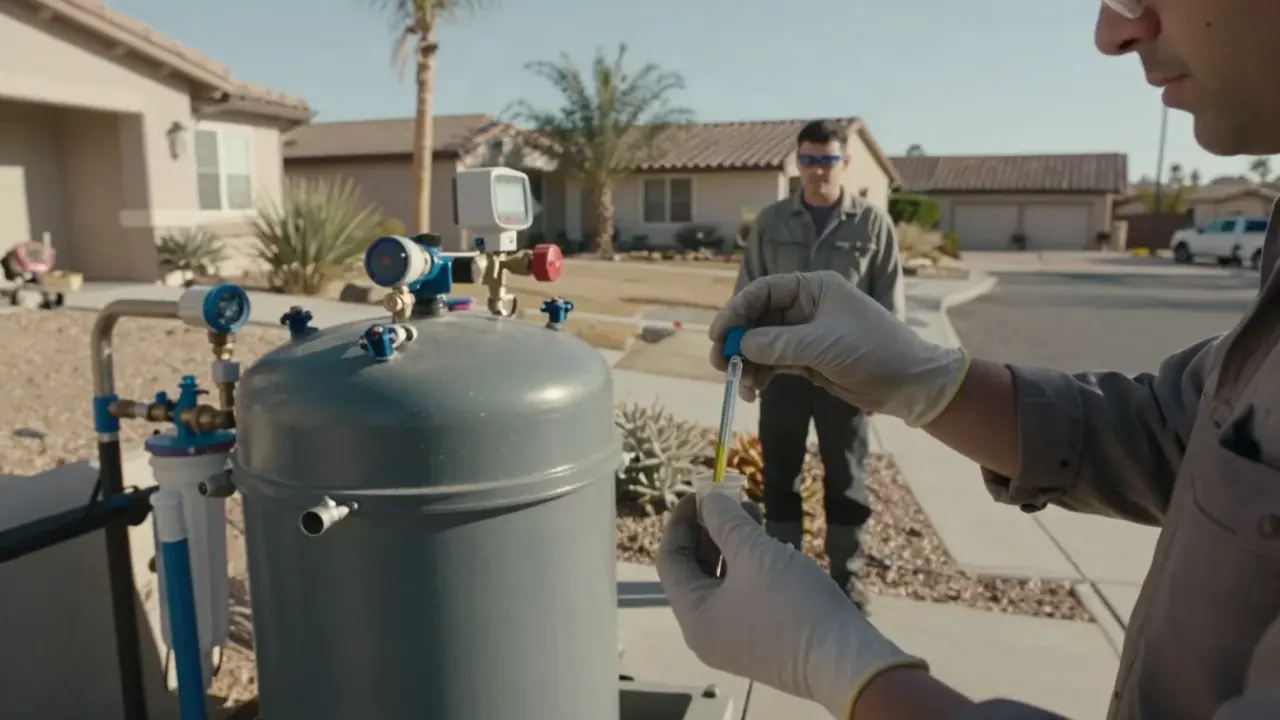
Most Diamond Bar households need to add salt to their water softener every 4 to 8 weeks. That range depends on how many people live in your home, how hard your water is, and how much water you use. If you have a family of four on Diamond Bar's typical 12 to 16 grains-per-gallon water, you are looking at a 40-pound bag of salt roughly every month to six weeks.
Below we break down exactly how to check your salt level, how much to add, the signs you waited too long, and the mistakes that quietly kill softener performance. We do this work every week across Diamond Bar and the surrounding hills, so these numbers come from real homes, not a manual.
How Often Should You Add Salt to a Water Softener?
How often should you add salt to a water softener is really a math question: your salt dose per regeneration divided by your daily water use. A standard 40,000-grain softener regenerates about every 3 to 4 days for an average family, and each regeneration pulls roughly 6 to 10 pounds of salt out of the brine tank. That works out to a 40-pound bag lasting 4 to 6 weeks.
Here is the quick reference we give customers:
- 1-2 people: refill every 8-10 weeks
- 3-4 people: refill every 4-6 weeks
- 5+ people or heavy irrigation: refill every 2-4 weeks
If you have a Salt-Free Water Conditioners Diamond Bar CA system, you skip this entirely - no salt, no brine tank, no refill schedule. But if you run a traditional ion-exchange softener, the salt is the fuel. Run it dry and the resin stops regenerating, which means hard water flows straight to your showers and appliances.
Why Salt Frequency Changes in Diamond Bar
Diamond Bar sits in a pocket of Southern California where the water arrives from a mix of imported Colorado River supply and local groundwater, and that blend runs hard - usually 10 to 16 grains per gallon, sometimes higher in the summer. Harder water means the softener has to work more often, and more regenerations means more salt burned.
Summer is the biggest variable. When temperatures push past 95°F in July and August, outdoor watering and pool top-offs can double a household's daily water draw. That extra volume runs through the softener, triggers more regeneration cycles, and can cut your salt refill window nearly in half. We see this every year in neighborhoods like Water Softener in Diamond Point, where larger lots and bigger families push softeners harder than a two-person condo near the golf course.
Winter flips it. Water use drops, regeneration slows, and a bag of salt that lasted five weeks in August might stretch to eight or nine by December. If you refill on a fixed calendar date instead of checking the tank, you will either overfill or run dry.
How to Check Your Water Softener Salt Level
Checking your salt level takes about 30 seconds and you should do it every two weeks. Here is the routine:
- Lift the lid on the brine tank - the tall, narrow tank next to your softener, not the resin tank.
- Look inside. You want the salt sitting at least 3 to 4 inches above the water line, and ideally the tank should be half to two-thirds full.
- If you see standing water with no salt above it, you are already running on empty and hard water is getting through.
- If the salt has formed a hard crust or a solid bridge across the top, break it up with a broom handle before adding more.
Never let the salt drop below the water line. Once the brine gets weak, the resin stops recharging properly and you will notice hard water within a week. If you are not sure whether your softener is even keeping up, a Water Hardness Testing Diamond Bar CA visit tells you exactly what is coming out of your tap.
How Much Salt to Add to a Water Softener
How much salt to add to a water softener depends on tank size, but the safe rule is to fill the brine tank no more than two-thirds full. For most residential units that is one 40-pound bag, sometimes two if you have a large 18-inch tank.
Do not top it off to the rim. Salt needs air space and water circulation to dissolve into brine. Overfill the tank and you get a solid block of salt that stops dissolving, which is worse than running low. We see this constantly on service calls - the homeowner kept adding a bag every two weeks out of habit and ended up with a 6-inch salt bridge that had not dissolved in months.
One more number worth knowing: a 40-pound bag of softener salt runs about $8 to $14 at Diamond Bar-area hardware stores in 2026. If you are buying four or five bags a month, your softener is either undersized for your household or running too many regeneration cycles - both fixable.
Signs Your Water Softener Needs Salt
Signs your water softener needs salt show up fast once the brine runs out. Watch for these:
- Spotty dishes and glassware straight out of the dishwasher
- Soap that will not lather - you use twice the shampoo and still feel residue
- Stiff, scratchy laundry and towels that feel like cardboard
- White scale on faucets, showerheads, and the inside of your kettle
- Dry, itchy skin after showers, especially in winter
- Water heater popping or rumbling as scale builds on the heating element
If two or more of those are happening at once, check the brine tank before you call anyone. Nine times out of ten it is simply empty. If the tank is full and you still have hard water, the problem is mechanical - a stuck valve, a failed control head, or exhausted resin - and that is a different repair.
What Type of Salt Should You Use in Diamond Bar?
Use evaporated or solar salt crystals for a standard softener, and avoid rock salt unless your manual specifically calls for it. Here is the breakdown:
- Evaporated salt pellets: 99.9% pure, dissolve cleanly, lowest risk of mushing or bridging. Best default choice.
- Solar salt crystals: slightly less pure, works fine, usually cheaper. Good for homes that go through a lot of salt.
- Rock salt: contains calcium and other minerals that leave sediment in the tank. Only use it if your manufacturer requires it.
- Potassium chloride: a salt-free-sodium alternative for people on sodium-restricted diets. Costs roughly 3 to 4 times more and needs a setting change on the control head.
Skip the "iron-fighting" blends unless you actually have iron in your water. In Diamond Bar, most homes deal with hardness, not iron, and the additives just cost more. If you are on well water or a private supply, get your water tested before you buy salt - you might be treating a problem you do not have.
Common Mistakes to Avoid When Adding Salt
The most common mistake is treating salt like a set-it-and-forget-it chore. It is not. Here is what we see on callbacks:
- Filling on a fixed schedule instead of checking the tank. Water use changes month to month. Look at the tank, not the calendar.
- Overfilling to the top. Anything above two-thirds full compacts and bridges.
- Ignoring a salt bridge. The tank looks full but the salt has crusted into a solid shelf above the water. Break it with a broom handle.
- Letting the tank run completely dry. Once the resin stops regenerating, it can take several cycles to fully recharge - and repeated dry spells shorten resin life.
- Using the wrong salt type. Rock salt in a softener designed for pellets is a slow-motion clog.
- Never cleaning the brine tank. Sediment and mold build up over years. A Brine Tank Cleaning Diamond Bar CA every 12 to 18 months keeps the system running clean.
If you have already made one of these mistakes, do not panic. Most are recoverable with a tank clean and a fresh bag of pellets. The one that is not cheap to fix is running the resin dry for months - that is when you start looking at a Resin Tank Replacement Diamond Bar CA instead of a $12 bag of salt.
When to Call a Professional
Call us when the brine tank is full and your water is still hard. That means the salt is not the problem - the softener is. Common culprits include a stuck regeneration cycle, a failed control head, a clogged injector, or resin that has worn out after 10 to 15 years of service.
We also get called when a softener starts leaking at the base, when the bypass valve is stuck, or when a unit that used to keep up suddenly cannot. Our team handles Water Softener Repair Diamond Bar CA on every major brand, and we will tell you straight whether a repair makes sense or whether you are better off replacing a unit that is past its useful life. If you are not sure what you have, start with a Water Softener Maintenance Diamond Bar CA visit - we test hardness, check the salt and brine, verify the regeneration cycle, and clean the tank in one trip.
If your softener is 15+ years old and you are paying for repairs twice a year, replacement usually wins. A new high-efficiency unit uses up to 30% less salt per regeneration, which pays back the cost over a few years. We handle Water Softener Installation Diamond Bar CA for homes across the city, including Water Softener in Cimarron Oaks and the surrounding neighborhoods.
Frequently Asked Questions
How often should I add salt to my water softener in Diamond Bar CA?
Every 4 to 8 weeks for most Diamond Bar households. A family of four on the city's typical 12-16 grains-per-gallon water uses about one 40-pound bag per month. Check the brine tank every two weeks and refill when the salt drops near the water line.
How do I know when to add salt to my water softener in California?
Lift the brine tank lid and look. If the salt sits less than 3 inches above the water line, or the tank is less than one-third full, add a bag. Spotty dishes, stiff laundry, and soap that will not lather are the household signs you waited too long.
What type of salt should I use in my water softener in Diamond Bar?
Evaporated salt pellets are the best default - 99.9% pure, dissolve cleanly, and rarely bridge. Solar salt crystals work fine and cost less. Avoid rock salt unless your manual requires it, and skip iron-fighting blends unless you have actually tested positive for iron.
Can I use potassium chloride instead of salt?
Yes, if you are on a sodium-restricted diet. Potassium chloride works in most softeners but costs 3 to 4 times more than standard pellets and requires a setting change on the control head. Expect to refill more often because it dissolves differently.
What happens if I never add salt?
The resin stops regenerating and your softener becomes a pass-through pipe. Hard water returns within a week, scale builds on your water heater and fixtures, and prolonged dry running shortens resin life - turning a $12 bag of salt into a $1,500 resin replacement.
Get Help with Water Softener in Diamond Bar
If your brine tank is full, your salt schedule is on track, and your water is still hard, something mechanical is wrong - and it will not fix itself. We diagnose softener problems across Diamond Bar and the surrounding hills, and we carry the parts to fix most of them on the first visit.
Call Diamond Bar Water Softener at (909) 415-2296 to schedule a service call or a Water Softener Diamond Bar CA system check. We will test your water, inspect the salt and brine, and tell you exactly what your softener needs.