Local GuidesRepair Tips
How Long Does a Water Softener Last
A water softener in Diamond Bar lasts 10 to 15 years on average, but hard water and heat can shorten that. Here's how to know when yours is done.
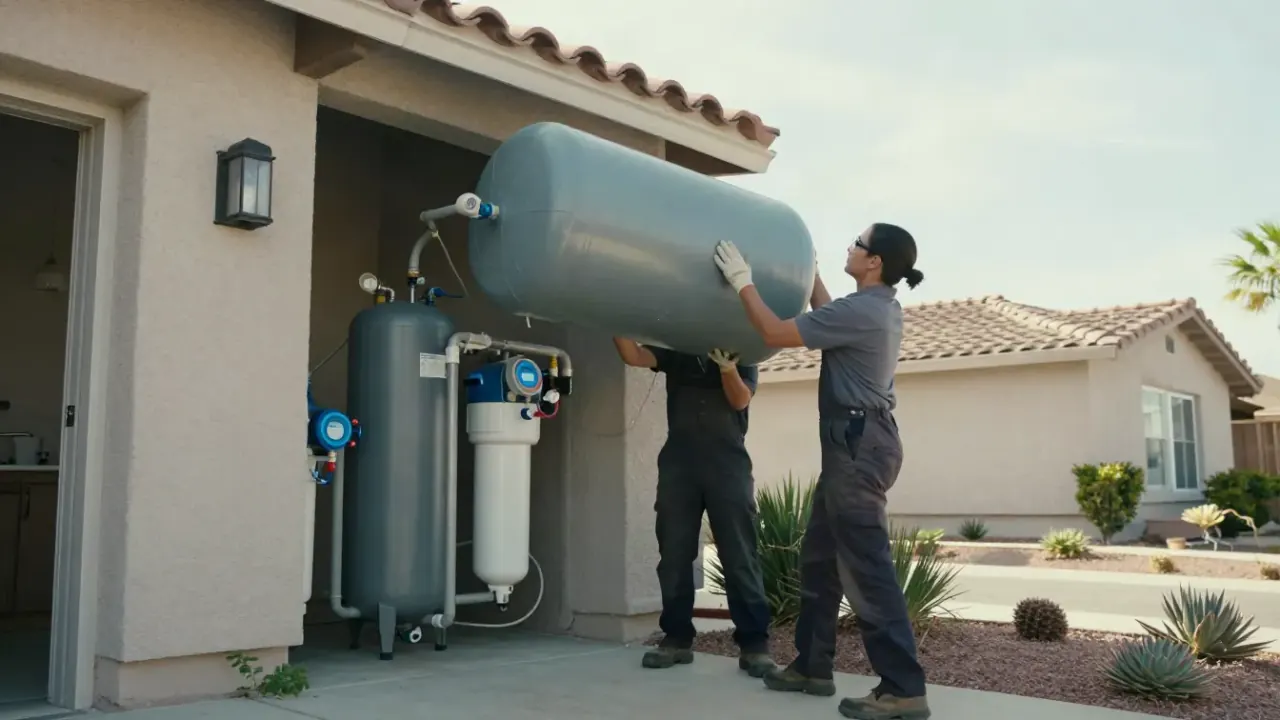
A water softener in Diamond Bar lasts 10 to 15 years on average, and most units we pull out of local garages died somewhere between year 11 and year 14. That range assumes you keep up with salt, clean the brine tank, and don't run the thing past the point where the resin is exhausted. Push a softener with a failing valve or iron-fouled resin and you can cut that lifespan down to 7 or 8 years. Below we break down what actually fails first, how Diamond Bar's water supply affects the clock, and the exact signs that tell you it's time to replace instead of repair.
If you already know your unit is on its last legs, our team handles Water Softener Removal and Replacement Diamond Bar CA and can usually get a new system running the same week. For everyone else, read on - the details matter more than the headline number.
How Long Does a Water Softener Last in Diamond Bar CA?
How long does a water softener last in Diamond Bar CA? Plan on 10 to 15 years for a quality unit, with the median landing around 12. That's the same range you'll see quoted nationally, but the local variables push some households toward the short end. Water hardness here runs 10 to 14 grains per gallon depending on which part of the city you're in and whether your supply is blended with imported water. That's solidly in the "hard" category, and hard water is the single biggest factor in how long the resin bed holds up.
Three things determine where your specific unit falls in that 10-to-15-year window:
- Resin quality and volume. A 1-cubic-foot resin tank on a 3-person household will exhaust faster than a 2-cubic-foot tank on the same house. Cheap big-box units often skimp here.
- Valve and control head brand. Fleck and Clack valves routinely hit 15 years. Off-brand plastic valves start sticking at year 7 or 8.
- Maintenance history. A softener that gets annual service and clean salt will outlast an ignored twin by 3 to 4 years, every time.
The average life of a water softener also depends on how hard the unit is working. A family of five in a 3,500-square-foot Diamond Bar home regenerates far more often than a retired couple in a 1,400-square-foot condo, and every regeneration cycle is wear on the valve and resin. More cycles, shorter life.
What Actually Wears Out First
Water softener lifespan is not one number - it's the shortest life among four components that fail on different schedules. Knowing which one is failing tells you whether you're looking at a $300 repair or a $2,200 replacement.
Resin beads (7-12 years)
Resin is the workhorse. Each bead is a tiny polystyrene sphere with charged sites that grab calcium and magnesium. Over thousands of regeneration cycles, those beads crack, and the charged sites get coated with iron and organic matter. Once 30 to 40 percent of the resin is fouled, the softener can't keep up - you'll see hardness creep back into your water even though the unit is still cycling normally. Resin usually dies before anything else.
Control valve and piston (8-15 years)
The valve is the mechanical brain. It moves a piston and seals to route water through the tank during service and regeneration. Seals harden, pistons score, and motors burn out. A sticking valve is the most common reason a 10-year-old softener starts leaking or running continuous regeneration. If you catch it early, Softener Valve and Control Head Repair Diamond Bar CA is a reasonable spend. If the valve body itself is cracked, replace the unit.
Brine tank and salt grid (10-20 years)
Brine tanks are plastic and last a long time, but the salt grid at the bottom cracks, and sludge builds up if you use cheap pellet salt or never clean the tank. A cracked grid means the softener pulls undissolved salt into the resin, which is bad. Brine tank cleaning every 12 to 18 months adds years to the whole system.
Bypass valve and plumbing connections (variable)
The plastic bypass valve on the back of the unit is a known failure point at year 8 to 12. It's a $40 part, but if it cracks while you're on vacation, you're looking at water damage, not just a repair bill.
Signs Your Water Softener Is Dying in Diamond Bar
Signs your water softener is dying in Diamond Bar usually show up in the shower before they show up on the unit. Here's what we tell homeowners to watch for, roughly in the order these symptoms appear.
- Soap stops lathering. If you suddenly need twice the shampoo to get a lather, the resin is exhausted or the unit isn't regenerating.
- Spots return on glassware. White film on dishes and shower doors is the classic hard-water tell. It means the softener is passing hard water straight through.
- Salt use spikes or drops to zero. A unit that suddenly eats a bag of salt every week is over-regenerating. A unit that hasn't touched its salt in two months isn't regenerating at all.
- Water feels slick or salty. Slick water means soft water is getting through but the brine isn't rinsing. Salty taste means the brine tank is overfilling.
- Brine tank is a solid block. If you can't break the salt with a broom handle, you've got a salt bridge and the unit has been running dry for weeks.
- Water pressure drops. Resin fines and iron sludge can plug the tank, restricting flow to the whole house.
- Visible leaks or continuous drain flow. A softener that runs water to the drain 24/7 is a valve failure. Shut off the bypass and call us.
Two or more of these together usually means the unit is past its useful life. One alone might just be a maintenance issue - a $150 tune-up can reset the clock if the resin is still good.
How Diamond Bar Water Changes the Math
Diamond Bar's water is hard enough that it measurably shortens softener life compared to softer regions of California. The city pulls from a mix of local groundwater and imported Metropolitan Water District supply, and hardness swings from about 9 grains per gallon up to 14 depending on the year and the blend. That's roughly 150 to 240 mg/L of calcium carbonate - solidly hard, but not the worst in Southern California.
What matters more is what's in the water besides hardness. Iron and manganese, even at low levels, foul resin faster than calcium does. If your water comes in with 0.3 ppm of iron, your resin will need replacement 2 to 3 years sooner than a neighbor on a cleaner blend. We test for this before recommending anything, and our Water Hardness Testing Diamond Bar CA is free for local homeowners.
Homes in older Diamond Bar neighborhoods - the tracts built in the 1970s and 1980s around Water Softener in Diamond Point and similar pockets - often have original copper plumbing and a first-generation softener that's already past 15 years. If your unit was installed when the house was built, it's done. Newer construction in the hills tends to have newer softeners but harder incoming water, which balances out.
Temperature matters too. Garage-installed softeners in Diamond Bar see summer temps over 100°F, and heat ages plastic valves and seals faster than the same unit in a climate-controlled utility room. If your softener lives in the garage, subtract a year or two from the expected lifespan.
Repair or Replace? A Straight Answer
Repair a water softener if it's under 8 years old and the problem is a single component - a valve, a motor, a bypass. Replace it if it's over 12 years old, or if you're facing two or more of these at once: failed resin, failed valve, leaking tank, cracked brine grid.
Here's the rough math for 2026 pricing in Diamond Bar:
- Valve or control head repair: $250-$550
- Resin tank replacement: $700-$1,200
- Brine tank cleaning and tune-up: $150-$250
- Full new softener installed: $1,800-$3,200 depending on size and brand
If a repair costs more than 40 percent of a new install on a unit that's already 10+ years old, replace it. You'll spend the same money twice in three years otherwise. Our Water Softener Repair Diamond Bar CA team will tell you straight which side of that line you're on - we don't sell replacements to people who just need a $200 part.
Common Mistakes That Shorten Water Softener Lifespan
Most premature softener deaths we see in Diamond Bar trace back to one of these five mistakes. Fix them and you'll get the full 15 years out of your unit.
- Letting the salt run empty for weeks. Running a softener without salt doesn't just stop softening - it lets hard water sit in the resin and re-foul it. Keep the tank at least one-third full.
- Using rock salt or cheap pellet salt. The binders and impurities in cheap salt build up as sludge in the brine tank. Use solar salt or high-purity pellets.
- Never cleaning the brine tank. Every 12 to 18 months, the tank needs to be emptied, scrubbed, and refilled. Skipping this is the number one cause of salt bridges.
- Ignoring hardness creep. If your water starts feeling hard again, don't assume it's the city's problem. Test it. Usually it's the resin.
- Setting regeneration too aggressively. Some installers set the unit to regenerate every night "to be safe." That's 365 cycles a year instead of 100, and it wears the valve out three times faster.
If you want to skip the guesswork, our Water Softener Maintenance Diamond Bar CA plan covers annual brine tank cleaning, hardness testing, valve inspection, and resin health checks. It's the cheapest way to add years to a unit you already own.
When to Call a Professional
Call us when you see water on the floor around the softener, when the unit runs continuously to the drain, when your water pressure drops after the softener, or when you've replaced the salt and cleaned the brine tank and your water is still hard. Those four symptoms almost always mean a valve, resin, or bypass failure that needs parts and a trained hand.
We're Diamond Bar Water Softener, and we work on every major brand - Fleck, Clack, Kinetico, Culligan, GE, Whirlpool, and the generic units builders installed in the 1990s and 2000s. We test your water first, tell you what's actually wrong, and give you a flat price before we start. No diagnostic fee on the first visit for Diamond Bar homeowners.
If your unit is genuinely at the end of its life, we also install new systems - from basic ion-exchange softeners to Salt-Free Water Conditioners Diamond Bar CA for households that don't want to deal with salt. Either way, you'll know the number before we touch a wrench.
Frequently Asked Questions
How long does a water softener last in Diamond Bar CA?
Ten to fifteen years, with 12 being the typical figure for a well-maintained unit. Diamond Bar's water runs 9 to 14 grains per gallon, which is hard enough to shorten lifespan by 1 to 2 years compared to softer regions. Garage-installed units in local summer heat lose another year or two.
How do I know when to replace my water softener in California?
Replace it when the unit is over 12 years old and you're seeing two or more failure signs - hard water returning, salt spikes, leaks, or a stuck valve. If a repair quote exceeds 40 percent of a new install on a unit past 10 years, replacement is the better call.
Can a water softener last 20 years in Diamond Bar?
Rarely, but it happens. A high-end unit with a Fleck or Clack valve, a 2-cubic-foot resin tank, annual maintenance, and a climate-controlled install location can hit 18 to 20 years. Most units that reach 20 years have had the resin replaced at least once.
Does hard water in Diamond Bar shorten softener life?
Yes. Harder water means more regeneration cycles per week, and every cycle wears the valve seals and resin. At 12 grains per gallon, a family of four regenerates roughly 30 percent more often than the same family on 6-grain water, which trims 2 to 3 years off the unit's life.
How much does a new water softener cost in Diamond Bar in 2026?
Expect $1,800 to $3,200 installed for a quality ion-exchange system, depending on tank size, valve brand, and whether you need plumbing modifications. Salt-free conditioners run $1,400 to $2,600. Removal and disposal of the old unit typically adds $100 to $200.
Get Help with Water Softener in Diamond Bar
Whether your softener needs a $200 valve repair or a full replacement, we'll test your water, diagnose the unit, and give you a flat price before any work starts. We serve all of Diamond Bar and the surrounding hills, and we stock the parts that fail most often so most repairs are done in one visit.
Call Diamond Bar Water Softener at (909) 415-2296 to schedule a free hardness test and a straight answer on your unit.