Water Treatment GuidesLocal Guides
Salt-Based vs Salt-Free Water Softeners Compared
Salt-based softeners remove hardness minerals with ion exchange; salt-free conditioners stop scale without removing minerals. Here's how they compare for Diamond Bar homes.
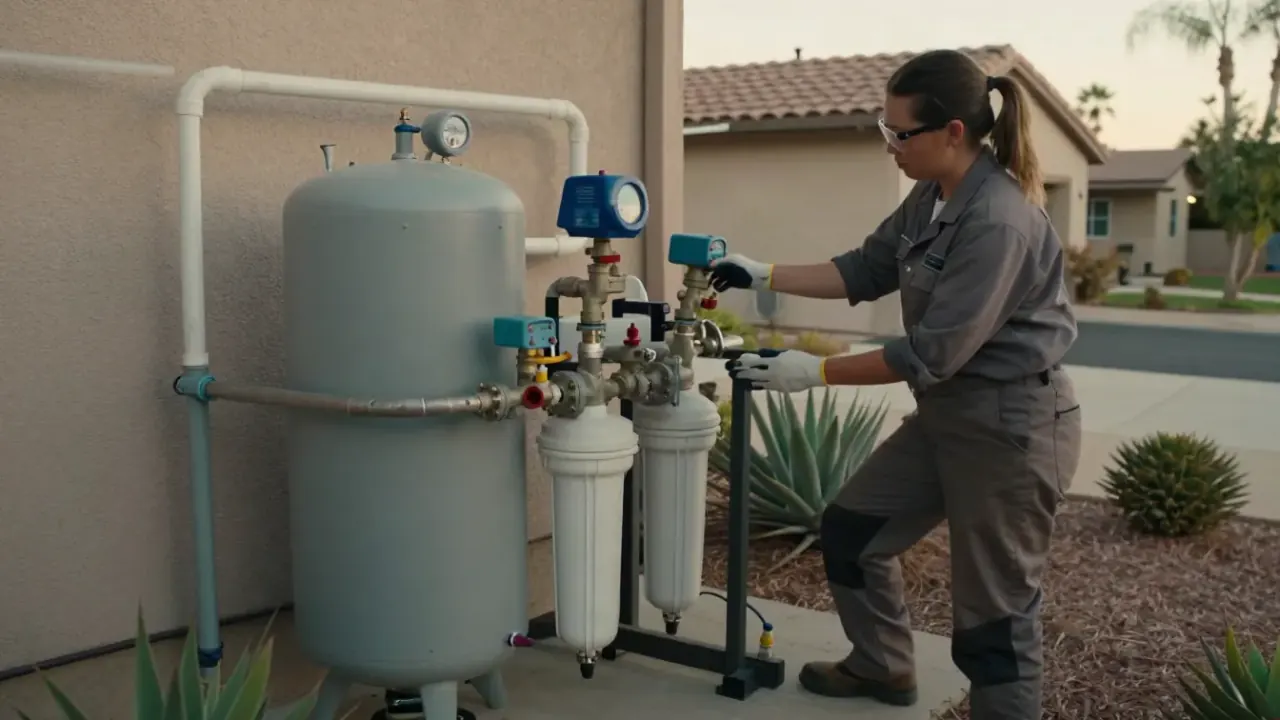
Salt-based water softeners remove calcium and magnesium from your water through ion exchange, while salt-free conditioners leave those minerals in the water and change their behavior so they don't stick to pipes and fixtures. That single difference drives everything else - cost, maintenance, how the water feels, and whether the unit is even legal to install in parts of California. For most Diamond Bar homes sitting on 12 to 18 grains per gallon of hardness, a salt-based system solves the problem outright; a salt-free unit is a scale-control tool, not a softener.
Below we break down how each system works, what they cost in 2026, and which one fits the water coming out of your tap. We install and service both types across Diamond Bar, so this isn't a sales pitch for one side - it's the same conversation we have at the kitchen table.
What Is the Difference Between Salt-Based and Salt-Free Water Softeners?
Salt-based vs salt-free water softeners is a comparison between two categories of equipment that both address hard water but do opposite things to the minerals in it. A salt-based softener is a true softener: it pulls calcium and magnesium out of the water and replaces them with sodium. A salt-free conditioner is a physical treatment device - it doesn't remove anything. The water still contains the same minerals; they've just been altered so they're less likely to form scale on heat exchangers and pipe walls.
That distinction matters because the words get used interchangeably in ads. If a product says "softener" but has no drain line, no salt, and no regeneration cycle, it's a conditioner. Real softening requires ion exchange resin, a brine tank, and a backwash cycle.
How Salt-Based Water Softeners Actually Work
A salt-based water softener runs your incoming water through a tank of polystyrene resin beads charged with sodium ions. Calcium and magnesium have a stronger positive charge than sodium, so they stick to the resin and sodium takes their place in the water. Every few days, the unit pulls brine from the salt tank, flushes the captured minerals down the drain, and recharges the resin. You add salt every four to eight weeks depending on hardness and household size.
The result is water that lathers with a fraction of the soap, leaves no white crust on shower glass, and stops the slow mineral buildup that kills water heaters and dishwashers early. In Diamond Bar, where the Metropolitan Water District blend runs hard, we typically see 12 to 18 grains per gallon - squarely in the range where a softener pays for itself in appliance life alone.
If you're starting from scratch, Water Softener Installation Diamond Bar CA usually takes three to four hours for a standard 32,000-grain unit, including a dedicated drain line and a bypass valve so you can still use water during service.
How Salt-Free Water Conditioners Actually Work
A salt-free conditioner uses a media tank - often a template-assisted crystallization (TAC) resin or a catalytic media - to convert dissolved calcium carbonate into microscopic crystals that stay suspended instead of depositing on surfaces. No salt, no electricity, no drain line, no wastewater. Water pressure alone pushes it through.
What it does not do is remove hardness. If you test the water after a salt-free unit, the grains-per-gallon reading is unchanged. What changes is the mineral's tendency to stick. For a homeowner in Water Softener in Windwood who mainly cares about spotting on faucets and scale inside the tankless water heater, that can be enough. For someone who wants softer-feeling water and less soap use, it won't deliver.
Salt-Based Water Softener Pros and Cons
Salt-based softeners are the only technology that genuinely removes hardness, and that's the headline pro. Everything else follows from it:
- Pros: truly soft water, soap and detergent savings of 50% or more, protection for water heaters and appliances, proven technology, widely serviceable.
- Cons: you buy and haul 40-lb salt bags, roughly 8 to 12 bags a year for a family of four; the unit discharges brine to the drain; it needs a power outlet and a drain line; and some California jurisdictions restrict brine discharge.
Maintenance is real but modest. Beyond salt, the resin lasts 10 to 15 years before it needs replacing, and the control valve benefits from a yearly check. We handle that with Water Softener Maintenance Diamond Bar CA - a tune-up that includes a hardness test, brine tank inspection, and valve cleaning.
Salt-Free Water Conditioner Benefits and Limits
Salt-free water conditioner benefits are mostly about convenience and footprint. There's no salt to buy, no brine to discharge, no electricity draw, and nothing to regenerate. The unit sits inline on your main and you forget about it for years. For rentals, condos, or homes where a drain line isn't practical, that's a genuine advantage.
The limits are just as real. Salt-free units don't soften water, so you'll still use the same amount of shampoo and dishwasher detergent. They don't remove existing scale - they only slow new formation. And performance varies with water chemistry; the harder your water, the less noticeable the effect. If your Diamond Bar home tests above 15 grains, we usually steer you toward ion exchange unless you have a specific reason to avoid salt.
Some homeowners pair a conditioner with Whole-House Water Filtration Diamond Bar CA to handle chlorine, sediment, and taste while the conditioner manages scale - a reasonable middle path when full softening isn't an option.
Which Water Softener Is Better in Diamond Bar CA?
For most Diamond Bar households, salt-based wins on results and salt-free wins on convenience - and the right pick depends on your water test, your plumbing, and whether you can discharge brine. Diamond Bar sits in a region where imported Colorado River and State Water Project supplies blend to a hardness that routinely lands between 12 and 18 grains per gallon. That's hard enough that the difference between the two technologies is obvious within a week of use.
Here's the decision framework we use on service calls:
- Test first. Anything above 7 grains per gallon is worth treating; above 10, salt-based is the clear answer.
- Check your drain options. Salt-based needs a discharge point. If you can't run one, salt-free or a filtration-only setup may be your only path.
- Match the unit to household size. A family of four in a 2,500 sq ft home typically needs a 32,000 to 40,000-grain unit.
- Consider the whole system. Softening plus carbon filtration handles hardness and taste together.
We see this play out differently across town. In Water Softener in Diamond Point, where a lot of homes were built in the 1980s and 1990s, original copper lines have often already taken a scale beating, so softening delivers immediate relief. Newer builds in Stonegate or The Country sometimes start with a salt-free conditioner and upgrade later once the family realizes the water still feels hard.
If you're weighing a switch, Water Softener Removal and Replacement Diamond Bar CA covers pulling an old unit, capping the lines, and setting the new one on the existing loop - typically a half-day job.
What to Watch Out For
The biggest mistake we see is buying a salt-free device expecting soft water. If the marketing says "no salt, no maintenance, no drain" and also claims "softens water," one of those claims is wrong. Salt-free conditioners are legitimate scale-control products; they are not softeners, and no amount of media formulation changes that.
Other common missteps:
- Sizing by price instead of grains. An undersized softener regenerates every day, burns through salt, and never quite keeps up.
- Skipping the bypass valve. Without one, every repair means shutting off water to the whole house.
- Ignoring the brine tank. Salt bridges and mushy salt layers stop regeneration silently. A yearly cleaning prevents it.
- Assuming all salt-free units are equal. TAC media and catalytic media behave differently; ask what's inside.
- Forgetting the drain line. A softener that discharges onto a slab or into a planter creates a mess and can violate local rules.
If your current softener is limping - salty-tasting water, hard water returning, or a valve stuck mid-cycle - the fix is often cheaper than replacement. Water Softener Repair Diamond Bar CA covers everything from a failed piston to a dead control board.
When to Call a Professional
Call us when you're not sure which technology fits your water, when your existing softener stops softening, or when you need a drain line run to a code-compliant discharge point. Testing, sizing, and installation are not DIY-friendly jobs - a wrong-sized unit or a bad drain connection costs more to fix than to do right the first time.
Our team at Diamond Bar Water Softener handles hardness testing, system selection, installation, and ongoing service for homes across the 91765 and 91789 ZIP codes. We'll test your water, tell you honestly whether you need a softener or a conditioner, and install whichever you choose. No pressure to buy the bigger unit.
Frequently Asked Questions
Which is better, salt-based or salt-free water softener in Diamond Bar CA?
Salt-based is better for most Diamond Bar homes because local water runs 12 to 18 grains per gallon and only ion exchange actually removes that hardness. Salt-free is the better pick when you can't run a drain line or want zero maintenance, but expect scale control, not soft water.
Do salt-free water softeners really work in California?
They work as conditioners, not softeners. They reduce new scale formation by 60% to 80% in most field tests, but they don't lower the grains-per-gallon reading. California regulations also restrict brine discharge in some areas, which is why salt-free units sell well here.
What is the difference between salt-based and salt-free water softeners?
Salt-based softeners remove calcium and magnesium through ion exchange and discharge them as brine. Salt-free conditioners leave the minerals in the water and alter their crystal structure so they don't stick to pipes. One removes hardness; the other only manages its effects.
How much does a water softener cost in Diamond Bar in 2026?
Installed salt-based systems typically run $2,200 to $4,500 depending on grain capacity and plumbing complexity. Salt-free conditioners installed run $1,800 to $3,200. Annual salt and maintenance for a salt-based unit adds roughly $120 to $200.
How often do I add salt to a salt-based softener?
A family of four in Diamond Bar adds 40-lb bags every four to six weeks, or about 8 to 12 bags a year. If you're filling more often than that, the unit is undersized or the regeneration settings need adjusting.
Get Help with Water Softener in Diamond Bar
Whether you land on salt-based or salt-free, the right call starts with a hardness test and an honest read on your plumbing. We'll test your water, walk you through both options, and install the system that actually fits your home.
Call Diamond Bar Water Softener at (909) 415-2296 to schedule your free water hardness test and get a straight answer on which system belongs in your house.